
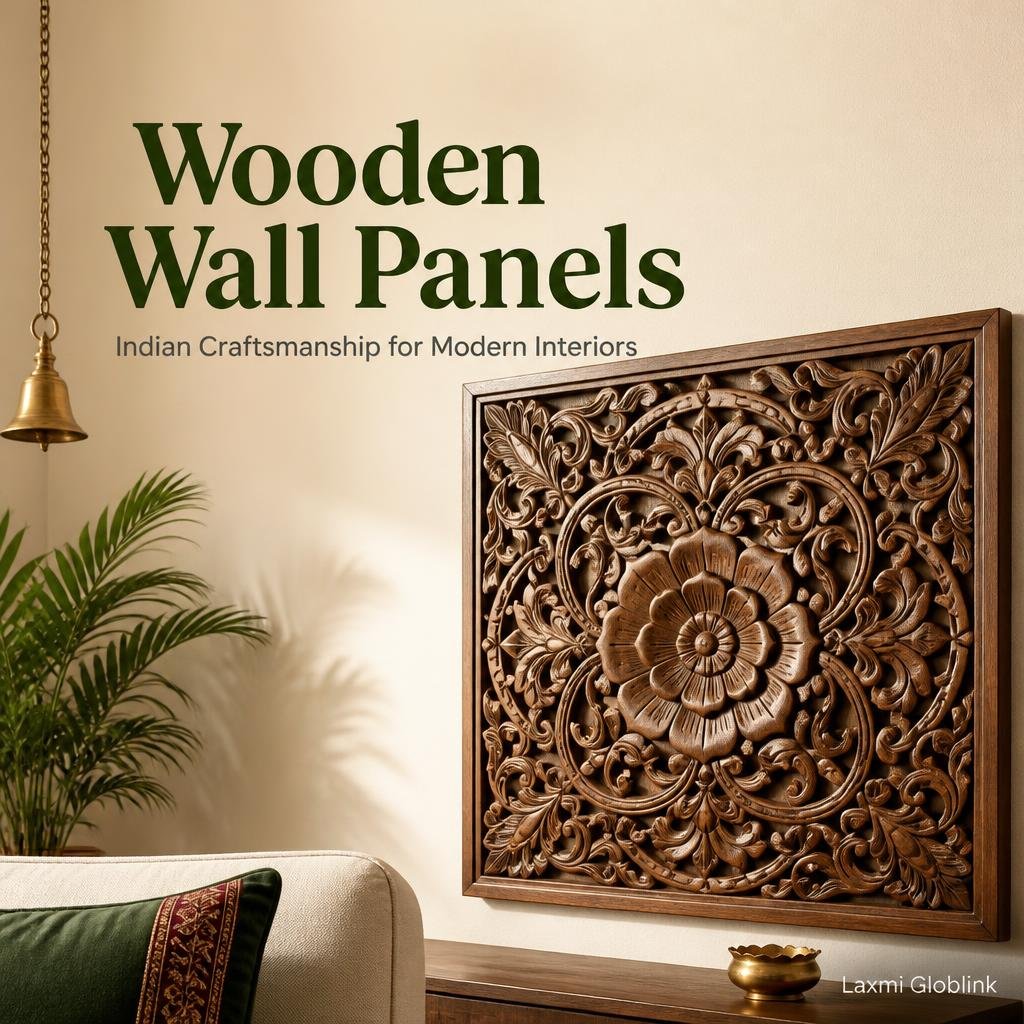
A Blank Wall Is a Missed Opportunity
Most interiors don’t fail because of bad furniture. They fail because the walls do nothing. A client spends a fortune on lighting and upholstery, and the largest surface in the room stays flat, painted, and forgettable. That’s usually the moment a designer starts looking at wall panels — and increasingly, at hand-carved wooden ones coming out of India.
Why Wooden Wall Panels Are Back on the Spec Sheet
Flat, minimal interiors had their decade. Now clients are asking for texture — something that catches light differently depending on where you stand in the room. Hand-carved wooden wall panels do that in a way that printed wallpaper or machine-routed MDF simply can’t replicate. Every groove has a slightly different depth, because a person cut it, not a machine following a repeating file.
This is where sourcing from India specifically matters. Wooden handicrafts have been a serious craft economy here for generations, with entire artisan clusters specializing in specific carving traditions passed down through families. When a designer sources a wooden wall panel from an experienced Indian exporter, they’re getting a finish that’s difficult to industrialize.
What Interior Designers Should Actually Look For
Not every “handcrafted” panel is built for international shipping and long-term use. Before specifying a supplier, it’s worth checking a few things:
- Wood seasoning and moisture treatment — panels headed to the US, UK, or Australia need to survive very different humidity conditions than they were carved in. Poorly seasoned wood warps or cracks within a year.
- Consistency across a bulk order — a single sample panel looking beautiful means nothing if panel 40 in a 60-panel order doesn’t match the carving depth or finish.
- Export packaging — wooden panels are surprisingly easy to chip in transit if a supplier hasn’t handled international freight before.
This is also where working with a manufacturer that holds GI tags and proper export licenses actually matters practically, not just as a credibility line. It usually signals a supply chain that has already solved the seasoning, consistency, and packaging problems most first-time buyers run into.
Where Wooden Wall Panels Are Showing Up
Designers aren’t only using these in traditional or “ethnic” interiors anymore. A carved wooden panel section works as a headboard backdrop in a otherwise modern bedroom, a reception-desk feature wall in a boutique hotel lobby, or a single accent panel behind a dining table where the rest of the room stays neutral. The craftsmanship carries the design; it doesn’t need an entire room built around it to make sense.
At Laxmi Globlink, this is a category we’ve spent real time in. Over 25 years working closely with copper and brass, and alongside that, wood, we’ve built relationships with more than 20 artisans across different carving specialties. What that means practically for a designer: we’re not sourcing a one-off panel from a single workshop and hoping it scales. We’ve served over 1,000 interior design clients on exclusive pieces, so we’ve already worked through the sizing, finishing, and shipping questions that come up on a real project timeline.
Customization Is Usually the Real Question
Very few designers want an off-the-shelf panel. They want a specific motif, a particular dimension to fit an existing wall, or a finish that matches other elements already specified in the room. That’s normal, and it’s the most common conversation we have with designers before a project moves forward. It’s also worth having that conversation early rather than after a layout is finalized, since carving lead times are real and worth planning around.
A Practical Next Step
If you’re currently speccing an interior where a flat wall is doing nothing for the room, wooden wall panels are worth a serious look, not as a decorative afterthought, but as a piece of the design that carries weight on its own.
If you’d like to talk through sizing, motifs, or a custom finish for a specific project, DM us directly. You can also visit www.laxmigloblink.com to see more of the range.


Pingback: Wooden Animal Statue vs Aesthetic Statue: What Sells Where - Laxmi Globlink