
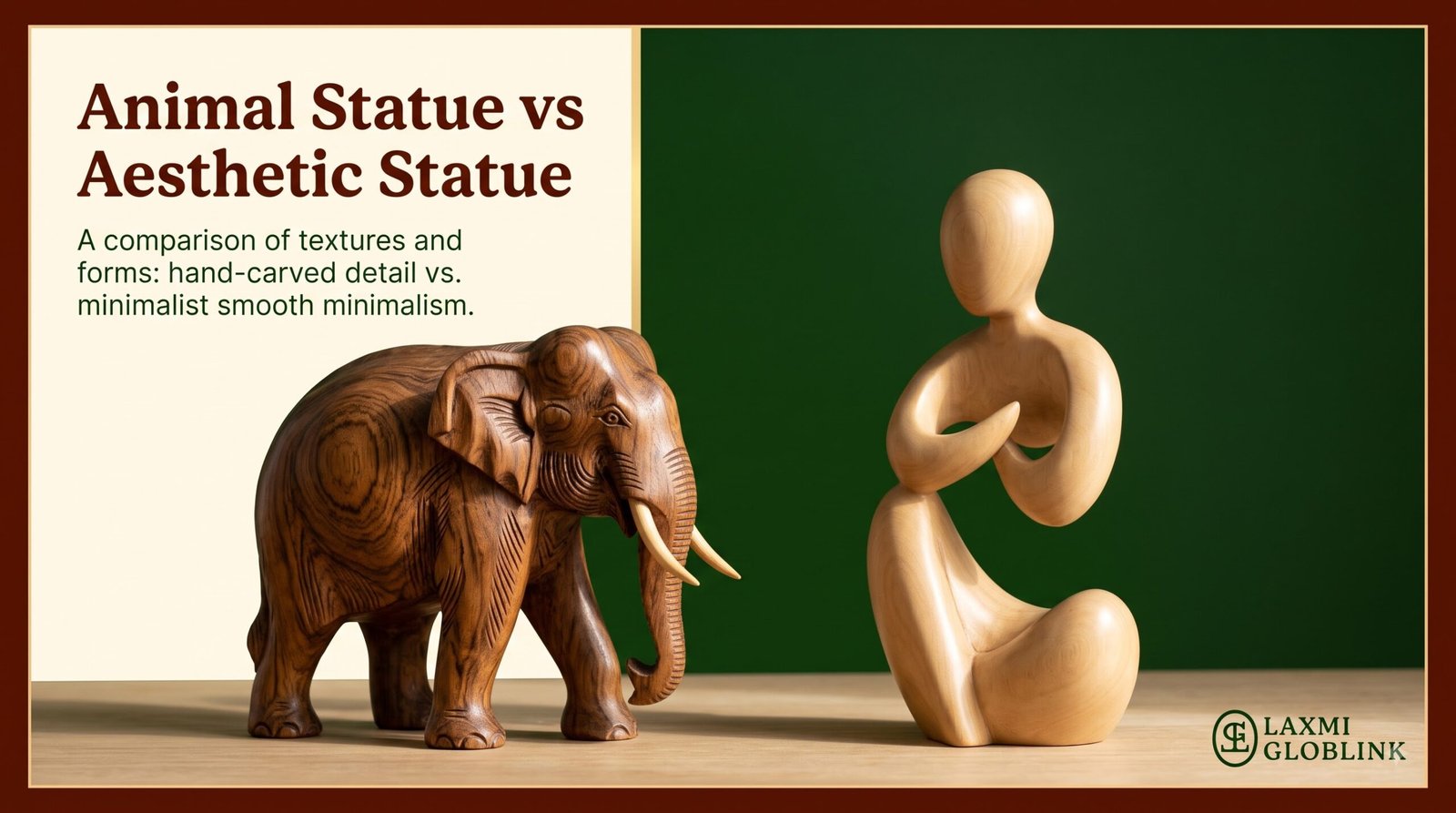
Two retailers can order from the same wooden statue catalog and get completely different results — one because the pieces matched what their customer actually wanted, the other because they didn’t. Wooden animal statues and wooden aesthetic statues aren’t interchangeable stock. They sell to different buyers, in different settings, at different price points — and knowing which one fits your market before you order saves you from a shelf full of pieces that just don’t move.
Table of Contents
- What Separates an Animal Statue from an Aesthetic Statue
- Where Wooden Animal Statues Sell Best
- Where Wooden Aesthetic Statues Sell Best
- How to Decide Your Assortment
- Key Takeaways
- FAQ
What Separates an Animal Statue from an Aesthetic Statue
A wooden animal statue is figurative — an elephant, horse, owl, or bird, carved to be recognizable at a glance. It tells a story on its own. Buyers often choose them for symbolism (elephants for strength or luck, owls for wisdom) as much as for looks.
A wooden aesthetic statue is more abstract or form-driven — flowing human figures, minimalist shapes, decorative silhouettes built around line and proportion rather than a literal subject. These pieces read as art objects first, decor second.
The distinction matters because it changes who buys them, where they’re displayed, and what price point the market will bear.
Where Wooden Animal Statues Sell Best
Animal statues tend to move fastest through gift shops, home decor boutiques, and retailers serving a customer who wants something with personality and meaning — not just a shape on a shelf. They also do well seasonally: elephants and owls in particular see a lift around festive gifting periods and housewarming purchases.
Because the subject is recognizable, animal statues also work well for entry-level and mid-range price points. A customer doesn’t need design context to appreciate a carved elephant — the piece explains itself. That makes it a strong fit for retailers targeting a broader, less design-literate buyer base.
We’ve seen this pattern consistently across our work with interior design clients over the years — figurative pieces tend to be the easier sell for a buyer’s first order, while aesthetic pieces are usually a second or third order once the retailer knows their customer’s taste.
Where Wooden Aesthetic Statues Sell Best
Aesthetic statues are a better fit for interior design showrooms, higher-end home decor retailers, and buyers whose customers are furnishing a specific look rather than picking up a gift. These pieces work as focal points — a console table centerpiece, a shelf statement piece, something chosen to complete a room rather than commemorate an occasion.
The trade-off is a narrower buyer. Aesthetic pieces need more context — good photography, thoughtful placement, sometimes a short description of the inspiration behind the shape — because the customer isn’t buying instant recognition, they’re buying design intent. Retailers who invest in that context tend to see stronger margins on these pieces than on animal statues, since the value is perceived as design-led rather than decorative.
How to Decide Your Assortment
Most retailers do best with a mix rather than picking one category outright. A practical starting split:
- New or gift-focused retailers: lean 70/30 toward animal statues, since they sell with less customer education needed
- Design-focused or showroom retailers: lean the other way, 70/30 toward aesthetic pieces, since your customer is already shopping with an eye for form
- Mixed-format retailers: an even split works well as a testing ground — track which category reorders first, then adjust your next order accordingly
Either way, source from a workshop that can produce consistent quality across both categories. Since carving technique differs — figurative detail work versus clean line and proportion — not every artisan cluster is equally strong at both, which is part of why we work across 20+ artisans rather than relying on a single workshop for the full wooden range.
Key Takeaways
- Animal statues sell on recognizability and symbolism; aesthetic statues sell on design intent and form
- Animal statues suit gift shops and broader retail; aesthetic statues suit design-led and showroom retail
- Animal statues are typically easier first orders; aesthetic pieces often earn stronger margins with the right context
- A 70/30 split in either direction (based on your customer base) outperforms a random mix
- Different carving skills apply to each category — sourcing quality depends on the artisan, not just the design
FAQ
Can I order a custom mix of animal and aesthetic statues in one shipment?
Yes, mixed-category orders are common, especially for retailers testing which category performs better with their customer base. Reach out to discuss what mix works for your order size.
Do aesthetic statues cost more than animal statues?
Pricing depends on size, wood type, and finish detail rather than category alone, so it varies order to order — worth confirming specifics for the pieces you’re considering.
What wood types are typically used for these statues?
This varies by piece and finish preference. It’s best to confirm wood type for the specific statues you’re sourcing, since it affects both look and durability.
Can statues be customized in size or finish for private label?
Customization is available for size, finish, and in some cases packaging branding, particularly for repeat or larger-volume buyers.
Is a sample available before placing a bulk order?
For first-time orders, requesting a sample piece is a reasonable step and one most buyers take before committing to volume.
If you’re weighing which mix fits your customer base, feel free to DM us — we’re happy to help you think through it. You can also browse the full wooden range at www.laxmigloblink.com.
Wooden Temples for Home: A Buyer’s Guide to Styles and Finishes
https://laxmigloblink.com/wooden-temples-for-home-buyers-guide/
Wooden Wall Panels: Bringing Indian Craftsmanship into Modern Interiors